
By Bob Ferrari · Published January 31, 2026 · Updated March 5, 2026
Selling your DVC contract is a bigger decision than most people give it credit for.
It's real estate, it's emotional, and for a lot of owners it feels like closing a chapter. Maybe the kids grew up and would rather backpack through Europe than ride Space Mountain. Maybe health issues have made travel harder. Divorce, job changes, annual dues that don't feel worth it anymore. All valid reasons, all more common than you'd think.
But here's something that gets overlooked: selling doesn't always mean leaving DVC. Plenty of owners sell one contract to buy another. They want a different resort, a better use-year, or a contract size that fits how they actually vacation now. Portfolio adjustments are a normal part of DVC ownership, and they go through the exact same process we'll cover here.
We've been obsessing over DVC resale data for years, tracking prices, analyzing trends, and helping thousands of owners understand the market. We're not here to push you toward selling. Honestly? If selling isn't right for you, we'll tell you that too. We'd rather you make the right decision than a fast one.
This guide covers everything you need to know about selling your DVC contract in 2026: what it's actually worth, what you'll actually pay, how long it actually takes, and whether selling is even the right call. We'll cover ROFR (spoiler: it's the buyer's problem, not yours), broker selection, and the rent-vs-sell question that trips up most owners.
If you're in a hurry: The market is in an interesting place right now. December 2025 saw unusually low inventory as buyers rushed to close before the new $500 Contract Administration Fee kicked in January 1, 2026. That rush has subsided, inventory is recovering, and we expect a more typical market for the rest of 2026. The $500 fee is still shifting buyer psychology, especially on smaller contracts where it stings more. If you're thinking about selling, this guide will help you understand whether now is actually the right time, or whether you'd be better off waiting, renting, or just holding on.
Let's dig in.
Table of Contents
- What Your Contract Is Actually Worth
- The Selling Process: Step by Step
- What You'll Actually Pay
- Choosing a Broker
- Should You Rent Instead?
- Common Mistakes to Avoid
- Frequently Asked Questions
What Your Contract Is Actually Worth
We'll start with the question everyone asks first: how much can I get for my DVC contract?
The honest answer is "it depends," but not in a wishy-washy way. It depends on specific, predictable factors that we can actually break down.
Current Market Snapshot (January 2026)
As of January 2026, the blended average across all DVC resorts was $125 per point. That's up about 3% from October, driven partly by a rush of buyers trying to close before the new $500 fee kicked in.
But averages are misleading. The DVC resale market is really 15+ different micro-markets, each behaving differently. Grand Californian contracts regularly sell for $264/point while Vero Beach hovers around $49/point. Same "product," wildly different values.
The resorts stack up like this:
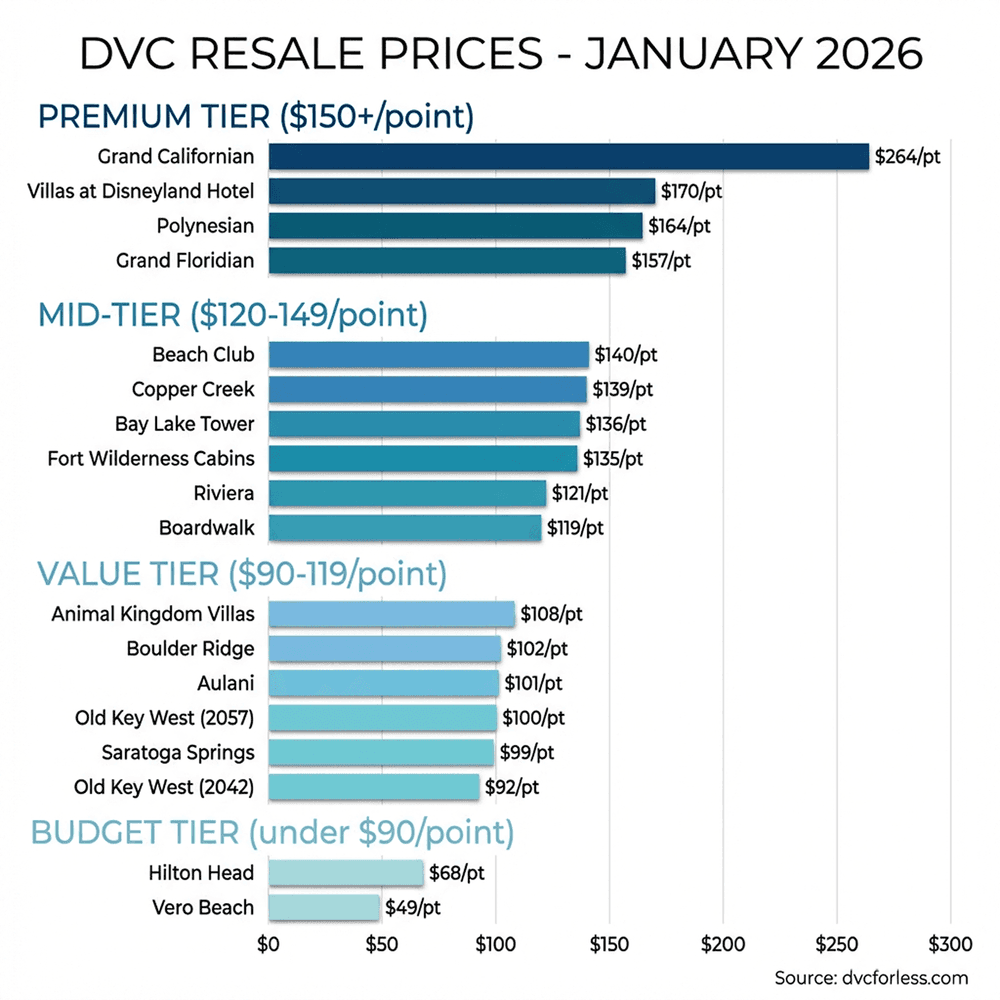
Prices based on January 2026 listing price data from major brokers.
What Drives Your Contract's Value
Beyond resort, several factors determine whether your contract commands a premium or a discount:
Contract Size
Smaller contracts (under 100 points) have traditionally commanded a slightly higher per-point price because they're more accessible to first-time buyers.
However, the new $500 flat fee may erode this premium over time. That fee represents 5-10% on a small contract versus just 1-2% on a large one, which
changes the math for budget-conscious buyers. Conversely, very large contracts (300+ points) can be harder to sell because the buyer pool shrinks as the
total price climbs.
Point Status: "Loaded" vs. "Stripped"
Buyers want loaded contracts (current-year points plus banked points from last year) because they get more points to use. That's potentially double the
vacation before they pay their first annual dues to Disney. Who wouldn't pay more for that?
A "stripped" contract (no points available until next use year) will sell, but expect a lower price per point.
Use Year
Earlier use years (January-March) tend to be slightly more desirable because they align well with booking windows for spring break and summer travel. But
honestly? This matters less than most sellers think. A well-priced contract sells regardless of use year.
Contract Expiration
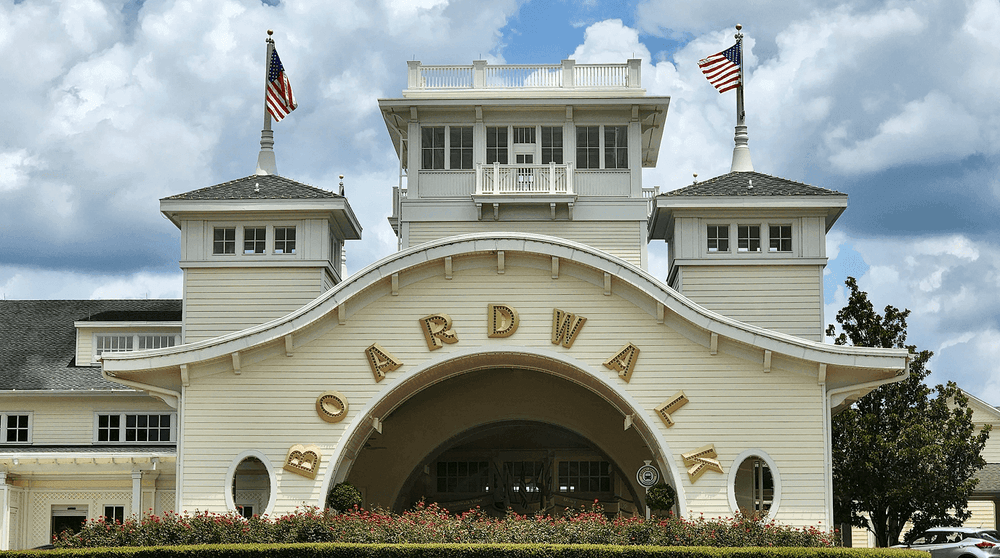
This is the elephant in the room for older resorts. Beach Club, BoardWalk, Boulder Ridge, Hilton Head, Vero Beach and the original Old Key West contracts
all expire in 2042. That's just 16 years of value remaining. The market is increasingly pricing these as "prepaid vacations" rather than long-term real
estate, which means accelerating depreciation.
If you own a 2042 resort and aren't planning to use it heavily over the next decade, the math may favor selling sooner rather than later.
Resale Restrictions (Newer Resorts Only)
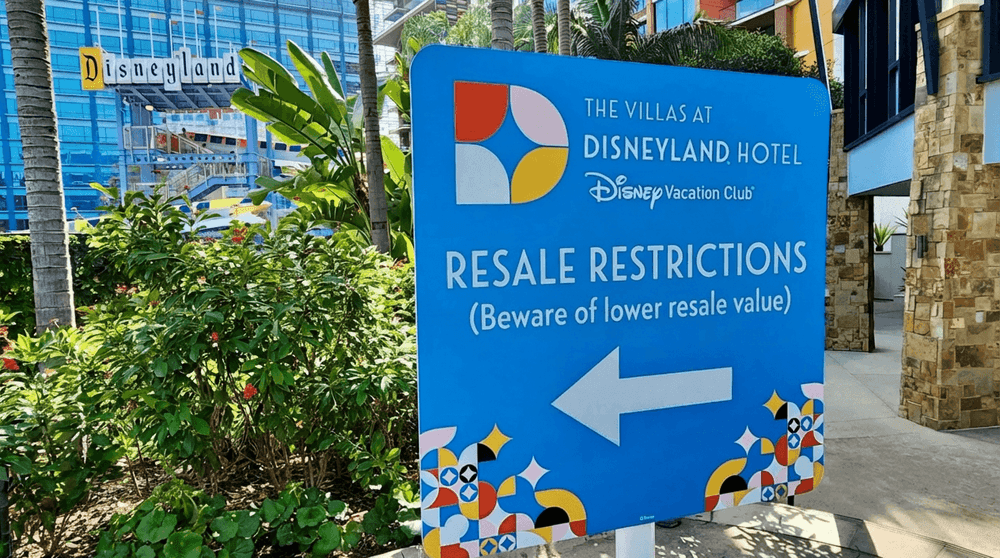
If you own at Riviera, Fort Wilderness Cabins, or Villas at Disneyland Hotel, there's something you should know: these contracts come with resale
restrictions that limit buyer appeal.
When someone buys one of these contracts on resale, they can only book at that resort. They lose access to the broader DVC system. No trading into Beach Club for a Food & Wine trip, no booking Polynesian for a quick weekend. For many buyers, that flexibility is half the appeal of DVC.
The result? These contracts face a smaller buyer pool. People who specifically want that resort will still be interested, but the casual DVC shopper looking for maximum flexibility will pass. That can mean longer time on market or more price sensitivity compared to unrestricted resorts.
This doesn't make your contract unsellable. Riviera still trades at $121/point, which is solidly mid-tier. But it's worth understanding why your buyer pool may be narrower than the headline numbers suggest.
The New $500 Contract Administration Fee
This needs addressing directly because it's reshaping the market in real-time.
Starting January 1, 2026, Disney implemented a $500 flat fee on all resale transactions. This gets added to the buyer's closing costs, though it's negotiable. Increasingly, buyers are asking sellers to split it or cover it entirely.
For larger contracts, $500 is a rounding error. On a $30,000 transaction, it's about 1.7%. But for smaller contracts, it's significant:
- 50-point contract at $100/pt = $5,000 sale → $500 fee = 10% of transaction
- 100-point contract at $100/pt = $10,000 sale → $500 fee = 5% of transaction
- 200-point contract at $100/pt = $20,000 sale → $500 fee = 2.5% of transaction
The practical impact? Small contracts now face headwinds. Buyers may push back harder on price to offset the fee, or the market may simply absorb it over time. We're still in the early innings, but sellers of smaller contracts should factor this into their pricing expectations.

The Financial Picture: Direct vs. Resale, Then vs. Now
One question sellers often ask: "Will I lose money when I sell?"
The answer depends entirely on how and when you bought.
If you bought direct from Disney recently (say, the past 5-7 years at today's premium prices), you'll likely sell at a loss compared to your purchase price. That's not a surprise and it doesn't mean DVC was a bad decision. DVC was never an investment in the stock-market sense. It was a prepaid vacation plan, and the real question is whether you got your money's worth in room stays, family memories, and not having to stress about Disney hotel prices every trip. For many families, that answer is a resounding yes.
If you bought direct years ago when prices were significantly lower, you may break even or even come out ahead. Direct prices have climbed steadily over the decades, and resale prices have followed. Someone who bought Saratoga Springs direct at $85/point in 2008 is looking at current resale prices around $99/point. That's not a loss.
If you bought resale, the math often looks even better. Resale buyers paid market rates from day one, which means you'll likely sell for roughly what you paid, or potentially more if the market has moved. That's one of the underappreciated benefits of buying resale: you didn't pay the Disney premium, so you're not eating a 30-50% discount on the way out.
The bottom line: if you're hoping to "get your money back," your expectations should match your situation. Recent direct buyers should calibrate for a loss. Long-time owners and resale buyers may be pleasantly surprised.
The Selling Process: Step by Step
Selling a DVC contract isn't like selling a car or listing something on eBay. It's a real estate transaction involving deeds, title insurance, and government recording. The process takes longer than most sellers expect, but it's predictable once you understand the stages.
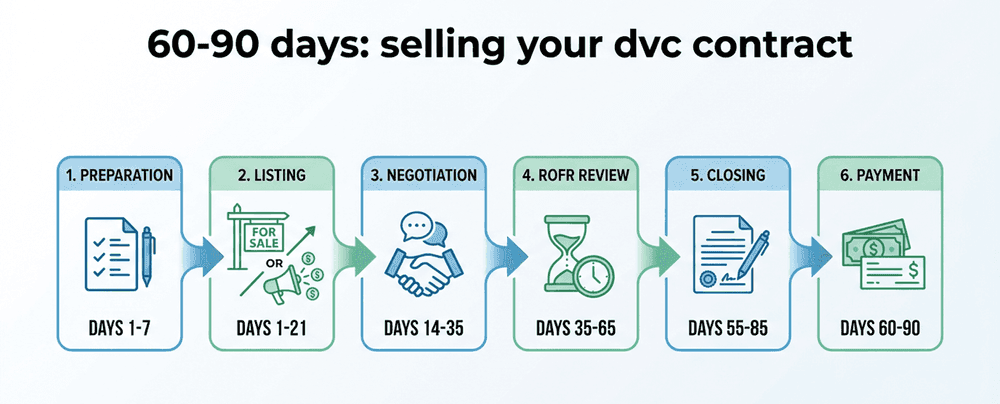
Total timeline: 60-90 days from listing to check in hand
We'll walk through each phase.
Phase 1: Preparation (Days 1-7)
Before you list anything, you need to know exactly what you're selling.
Gather Your Contract Details
- Log into your DVC member account and download your Point Activity Summary
- Confirm: resort, number of points, use year, contract expiration date
- Document point status: current year points, banked points, any borrowed points
- Verify the names on your deed are accurate. Has anyone passed away, gotten divorced, or legally changed their name since purchase? These situations require additional paperwork and can delay closing if not addressed upfront.
Understand Your Point Status
This trips people up more than almost anything else. Buyers want to know: how many points will they actually get, and when?
- Current Year Points: Points that loaded this use year
- Banked Points: Last year's points saved for this year
- Borrowed Points: Next year's points used early (these come out of the buyer's future allocation)
If you've borrowed heavily or have complicated point arrangements, be prepared to explain them. Any discrepancies discovered during closing will create delays.
Check for Outstanding Dues
All annual dues must be current. Any unpaid amounts become liens that complicate closing. If you're behind, get caught up before listing.
Check for Outstanding Loans
If you financed your purchase through Disney or a third-party lender, request your payoff amount before listing. The loan balance gets paid from your sale
proceeds at closing. If you owe more than the contract is worth (it happens, especially with recent direct purchases), you'll need to bring money to the
table to close.
What If You Have a Trip Planned?
One thing that catches many sellers off guard: any reservations you've made will be cancelled when ownership transfers. They don't transfer to the buyer.
If you've got a trip booked for August and your contract closes in June, that reservation is gone.
You have two options:
- Take your trip first, then close. You can list your contract with a "delayed closing" stipulation, meaning the actual transfer happens after your vacation ends. All the paperwork (offer, ROFR, title work) can proceed in parallel, but the deed doesn't record until you're back. The downside? Some buyers won't wait. If your trip is four months out, you're asking a buyer to sit around while you vacation. That can make your contract harder to sell.
- Cancel the reservation and close normally. If the trip isn't essential, canceling gets your points back (subject to DVC's cancellation policies) and lets you proceed with a standard closing timeline. Those points then transfer to the buyer.
If you're planning to list soon but have an upcoming trip, think carefully about which path makes sense. A delayed closing isn't a dealbreaker for all buyers, but it narrows your pool.
Phase 2: Listing (Days 1-21)
Once you've got your documentation in order, it's time to list.
Broker Selection
Unless you have significant real estate experience and a high tolerance for complexity, we strongly recommend using a licensed DVC resale broker. More on
how to choose one in the broker section below.
Listing Agreement
You'll sign a listing agreement specifying:
- Your asking price
- The broker's commission (typically 7.9%-10%)
- Listing duration
- Marketing approach
Pricing Strategy
This is where many sellers go wrong. Overpricing is the #1 reason contracts sit on the market for months.
In a balanced market (which is where we're headed after the December 2025 rush subsided), pricing correctly from day one matters more than ever. "Some flexibility" doesn't mean "price 15% above recent sales." Look at what similar contracts actually sold for in the past 60-90 days, not what they're listed for.
A well-priced contract typically receives offers within 14-21 days. If you're not getting interest, that's feedback.
Phase 3: Negotiation & Offer (Days 14-35)
When offers come in, they'll specify:
- Price per point (and total price)
- Who pays closing costs
- Any contingencies
- Target closing date
Fair warning: Your first few offers might be lowball offers. There are bargain hunters out there hoping to catch a desperate seller. A good broker will present these offers (they're obligated to), but you're under no obligation to accept. If someone offers $20/point below your listing on day three, that's not "the market talking." That's someone trying their luck.
2026 Trend Alert: Buyers are increasingly asking sellers to pay or split the new $500 admin fee. This is negotiable, and we're seeing it go both ways.
Dues Proration
Something sellers often overlook: you may get reimbursed for a portion of the annual dues you've already paid.
The principle is simple: whoever receives the points pays the dues for those points. It's not about calendar months. It's about point access.
If you've paid your 2026 dues in full and the buyer receives the full 2026 point allotment, they reimburse you for those dues at closing. If your contract is "stripped" (no current-year points available), you keep that dues liability since the buyer isn't getting those points anyway.
Example: You sell a 160-point Saratoga Springs contract. You've paid $1,327 in 2026 dues. The buyer gets the full 2026 points, so they reimburse you $1,327 at closing. That's money back in your pocket that partially offsets selling costs.
One note: these are industry conventions, not contractual requirements. The exact allocation is spelled out in your purchase agreement and can be negotiated. Most deals follow the "points = dues" principle, but everything is technically on the table.
Once you've agreed on terms, the buyer puts down a deposit (typically 10%) and you sign the purchase agreement.
Phase 4: ROFR, The Waiting Game (Days 35-65)
ROFR (Right of First Refusal) is Disney's contractual right to match any accepted offer and buy the contract themselves. Disney officially has 30 days to decide, though recent turnaround times have ranged from 9-30 days.
What sellers need to know: ROFR is the buyer's problem, not yours.
If Disney exercises ROFR, you still get paid. Exactly the same amount, on the same terms. The only difference is Disney becomes your buyer instead of the original purchaser. As one broker put it: "Either the buyer gets your contract or Mickey Mouse does — either way, you get your money."
The 2025 numbers: 96.1% of contracts passed ROFR. Disney only bought back 3.9%. The risk is higher at certain resorts (Grand Californian sees 29-33% buybacks, Grand Floridian 17-18%), but for most resorts it's under 5%.
The only scenario where ROFR hurts you: if you've dramatically underpriced your contract. A Disney buyback at a below-market price is basically them saying "thanks for the discount." Price correctly and this isn't a concern.
Phase 5: Estoppel & Closing (Days 55-85)
Once ROFR is waived (and statistically, it will be), the deal moves to closing.
Estoppel Certificate
The title company requests an estoppel certificate from Disney, essentially a verification that your account is in good standing with no liens, unpaid
dues, or reservations that complicate the transfer. This costs $150 and takes up to 30 days, though often faster.
This is the stage where sellers often get frustrated. You've cleared ROFR, the finish line is in sight, and then... more waiting. It's like being stuck in a FastPass return line that just. keeps. moving. slowly. The good news: it's purely administrative. Nothing dramatic happens here. It's just Disney's bureaucracy doing its thing.
Closing Documents
You'll receive:
- The deed
- Transfer affidavits
- Various legal documents
Most documents can be signed electronically or via Remote Online Notarization, which is a huge improvement over the old days of tracking down physical notaries.
Phase 6: Getting Paid (Days 60-90)
Funding & Recording
The buyer wires funds to the title company escrow account. Once all signatures are in, the deed is recorded with Orange County (or the relevant
jurisdiction for HHI, Vero Beach, or Aulani). Note: Aulani closings often take a bit longer due to Hawaii's specific title laws and processes.
Your Payout
Sellers typically receive funds via wire transfer within 24-48 hours of deed recording. Some title companies still cut checks if you prefer.
Post-Closing
Disney takes another 2-4 weeks to update their system and transfer the membership to the new owner. But this doesn't affect you. You're already paid and
done at this point.
What You'll Actually Pay
Most sellers walk away with about 90-92% of the sale price. The rest goes to commission and a small fee to Disney.
Here's the breakdown:
Seller pays:
- Commission: 8-10% of sale price (this is the big one)
- Estoppel fee: $150 to Disney
Buyer pays:
- Closing costs ($500-$900+)
- Disney's new $500 admin fee
- Dues reimbursement to you for any points they're receiving that you already paid dues for
That split is standard, but everything is negotiable depending on market conditions. If you have an outstanding loan on your contract, the payoff comes out of your proceeds first.
What This Looks Like in Practice
Example 1: Saratoga Springs (160 points at $99/pt)
Sale price: $15,840 → After commission and estoppel: $14,264 → Plus dues reimbursement (+$1,327): $15,591 net
Example 2: Copper Creek (250 points at $139/pt)
Sale price: $34,750 → After commission and estoppel: $31,472 → Plus dues reimbursement (+$2,380): $33,852 net
Example 3: Polynesian, stripped (75 points at $164/pt)
Sale price: $12,300 → After commission and estoppel: $11,043 → No dues reimbursement (points already used): $11,043 net
The difference between Examples 1-2 and Example 3? Whether you still have points to transfer. If you do, the buyer reimburses you for the dues you already paid. If you've used the points, the buyer obviously won't need to reimburse you for the dues you paid.
Tax Implications (Brief Overview)
Capital Gains
If you sell for more than your cost basis (original purchase price + closing costs), you may owe capital gains tax. Most sellers actually sell at a loss
compared to their direct purchase price, which limits tax exposure. But losses on personal-use property generally aren't deductible.
Foreign Sellers (FIRPTA/HARPTA)
If you're not a U.S. resident, mandatory withholding applies:
- FIRPTA (federal): 15% of gross sale price
- HARPTA (Hawaii, Aulani only): 7.25% additional
This withholding isn't a tax. It's a prepayment that you may recover through tax filing. But it significantly impacts your immediate liquidity.
Standard Disclaimer: We are not tax professionals. Your situation is unique. Consult a qualified tax advisor before closing to understand your specific obligations.
Choosing a Broker
Unless you have real estate experience and enjoy complex transactions, we recommend using a licensed DVC resale broker. We'll explain why, and how to choose one.
Why You Probably Want a Broker
FSBO (For Sale By Owner) Risks:
- No professional liability insurance (if something goes wrong, you're on your own)
- Limited marketing reach (you're competing against brokers with 100,000+ email subscribers)
- Contract drafting risk (improperly drafted agreements can be unenforceable)
- ROFR navigation (managing Disney's process without expertise is tedious)
- Title company coordination (lots of back-and-forth you'd rather not do)
What Brokers Provide:
- Access to large buyer databases and marketing channels
- Legally vetted contracts
- Pricing guidance based on actual sales data
- ROFR management
- Closing coordination
- Errors & omissions insurance
- Experience handling edge cases
DVC Resale Brokers
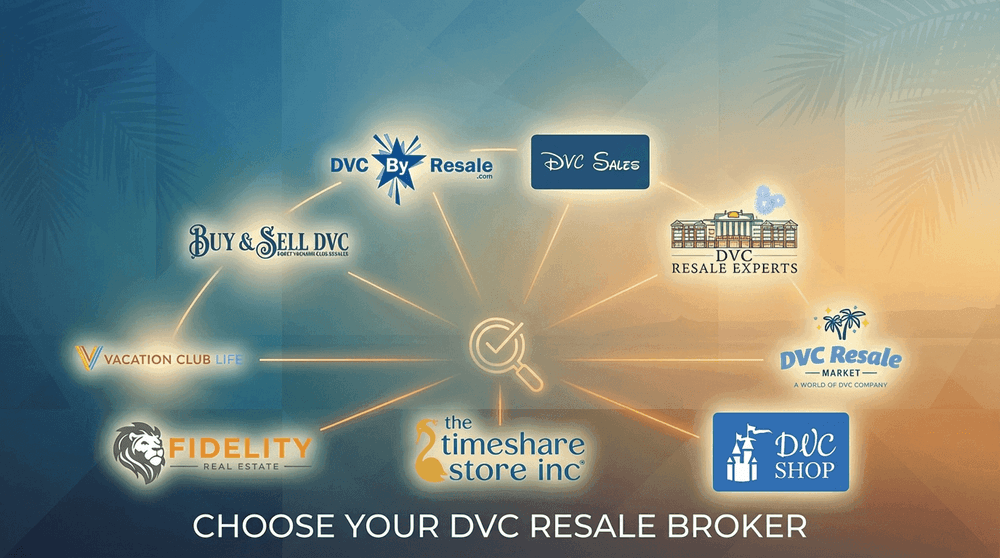
There are about a dozen licensed brokers who specialize in DVC resale. The two highest-volume are DVC Resale Market and Fidelity Real Estate, both with large buyer databases and significant marketing reach. But volume isn't everything, and smaller brokers can sometimes offer more personalized service or lower commissions.
Here are the major players:
| Broker | Website |
|---|---|
| DVC Resale Market | dvcresalemarket.com |
| Fidelity Real Estate | fidelityrealestate.com |
| DVC Store | dvcstore.com |
| DVC Shop | dvcshop.com |
| Buy and Sell DVC | buyandselldvc.com |
| DVC by Resale | dvcbyresale.com |
| DVC Sales | dvcsales.com |
| Vacation Club Life | vacationclublife.com |
| DVC Resale Experts | dvcresaleexperts.com |
Commissions typically range from about 8% to 10% of the sale price. Most brokers publish their rates on their websites, so you can compare before reaching out. One thing to know: some brokers will negotiate their commission percentage, while others have fixed rates and won't budge. It never hurts to ask, but don't assume every broker is flexible.
What to Look For In a Broker
1. DVC Specialization (Non-Negotiable)
General timeshare brokers don't understand DVC's nuances. Use someone who specializes. All the brokers we listed above specialize in DVC.
2. Licensing
Florida real estate license at minimum (most DVC contracts are Florida-based). Verify on your state's licensing database.
3. Track Record
- How many contracts sold in the past 12 months?
- What's their average days-on-market?
- Can they show you recent comparable sales?
4. Marketing Reach
- Website traffic and Google rankings for DVC terms
- Email list size
- Social media presence
- Do they have active buyer waiting lists?
5. Communication
- How quickly do they respond to inquiries?
- Will you have a dedicated point of contact?
- How often will you get listing updates?
Questions to Ask Before Signing
- What is your exact commission rate? Any hidden fees?
- How many DVC contracts did you sell in the past 6 months?
- What percentage sold within 30 days? 60 days?
- How do you recommend pricing my specific contract?
- Where do you market listings?
- Who will be my primary contact throughout the process?
- How do you handle ROFR submission and closing coordination?
A good broker will answer these questions confidently and specifically. Vague answers are a red flag.
Quick Sale Programs
Some brokers offer "instant sale" or "quick sale" programs where they (or a partner) buy your contract directly at a below-market price. You skip the listing period entirely and sign contracts immediately.
This isn't for everyone. You'll typically get 10-20% less than you would on the open market. But if you need to sell fast, don't want to deal with showings and negotiations, or just want certainty, it's an option worth asking about. Not all brokers offer it, and not all contracts qualify.
The Commission vs. Speed Tradeoff
Worth considering: on a $20,000 sale, the difference between an 8% and 10% commission is $400. That's real money. But a lower-commission broker isn't a better deal if your contract takes three months longer to sell.
Every month your contract sits on the market, you're paying dues (typically $8-12 per point per year). On a 200-point contract, that's $1,600-2,400/year in carrying costs.
If a higher-commission broker sells your contract two months faster, you might actually net more money. Run the numbers for your specific situation.
Should You Rent Instead?
Before we wrap up, let's address the elephant in the room: maybe you shouldn't sell at all.
Renting your points is a legitimate alternative that keeps your membership active while generating income. We'll walk you through how to think about this decision.
Current Rental Payouts (January 2026)
Major Rental Broker Rates:
| Platform | Premium Resorts (7-11 mo booking) | Standard Rate |
|---|---|---|
| DVC Rental Store | $18/pt | $16/pt |
| David's Vacation Club | $18/pt | $16/pt |
| DVC-Rental | $18/pt | $18/pt |
What You'll Actually Net:
Rental income minus annual dues equals your profit per point. Note: these examples are illustrative. Actual rental payout will vary depending on the rental
agency.
| Resort | Rental Payout | 2026 Dues | Net Profit/Point |
|---|---|---|---|
| Polynesian | $18/pt | $8.33/pt | $9.67/pt |
| Copper Creek | $17/pt | $9.52/pt | $7.48/pt |
| Animal Kingdom | $17/pt | $9.42/pt | $7.58/pt |
| Saratoga Springs | $16/pt | $8.29/pt | $7.71/pt |
| Old Key West | $16/pt | $11.21/pt | $4.79/pt |
One thing to keep in mind: rental income is taxable as ordinary income, so your actual take-home depends on your tax bracket. (We're not tax advisors—consult a professional for your specific situation.)
The Rent vs. Sell Framework
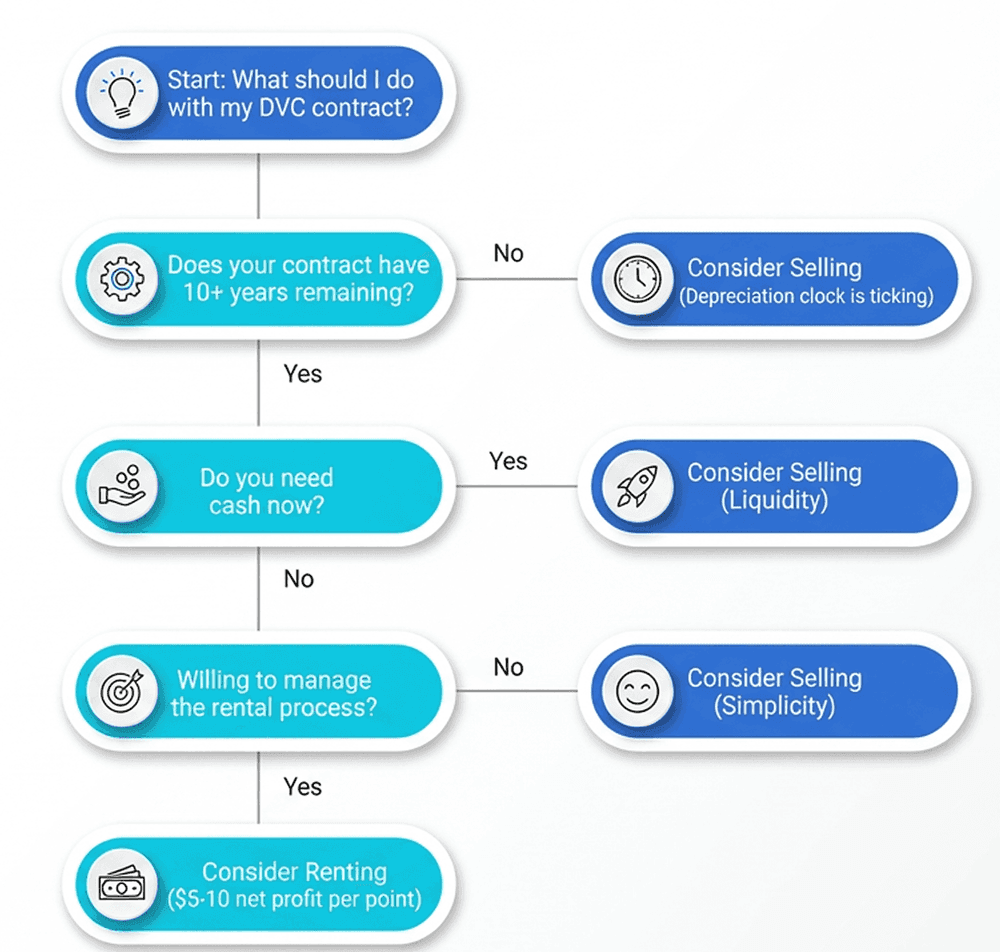
Renting Makes Sense If:
- You have 10+ years remaining on your contract
- You're willing to actively manage the rental process (or use a broker)
- You want ongoing income rather than a lump sum
- Current market prices feel low to you
- You might want to use your points occasionally in the future
Selling Makes Sense If:
- You're done with DVC, mentally and emotionally
- Annual dues feel burdensome
- You need liquidity now
- Your contract expires within 10 years (depreciation clock is ticking)
- You don't want to manage rentals or worry about points expiring
- Market conditions are favorable (like Dec 2025, when inventory was at historic lows)
The Hybrid Approach
Some owners do both: rent points for 2-3 years to recover some costs, then sell when the contract is "paid for" or when market conditions improve.
This approach works best if you're patient and organized. It's not for everyone.
A Note on Policy Risk
We should mention: Disney monitors rental activity. The member agreement prohibits "commercial use," and Disney has issued warnings to some high-volume renters.
Occasional renting through established brokers is fine. Running a personal rental empire with dozens of reservations? That's pushing it. Use good judgment.
Common Mistakes to Avoid
After tracking thousands of DVC resale transactions, we've seen the same mistakes trip up sellers repeatedly. Don't make them.
1. Overpricing Your Contract
This is the #1 killer. Sellers look at listing prices instead of sold prices and assume they can get top dollar. Then their contract sits for months while they pay dues with no income.
The Fix: Look at what similar contracts actually sold for in the past 60-90 days. Price realistically from day one.
2. Not Understanding Your Point Status
Surprises at closing are bad for everyone. If your points are complicated (heavy borrowing, holding accounts, reservations), document everything upfront.
The Fix: Download your Point Activity Summary before listing. Review it with your broker.
3. Choosing the Wrong Broker
Going with your cousin's friend who "sells real estate" is a recipe for frustration. DVC resale is specialized work.
The Fix: Use a licensed broker who specializes exclusively in DVC.
4. Trying to Time the Market
DVC resale prices fluctuate, but they're not the stock market. Waiting for the "perfect" moment usually just means paying more dues while you wait.
The Fix: If you've decided to sell, sell. The best time is when you're ready.
Frequently Asked Questions
How long does it take to sell a DVC contract?
Expect 60-90 days from listing to receiving payment. This includes 2-3 weeks to find a buyer, 30 days for Disney's ROFR review, and 2-4 weeks for closing paperwork.
How much does it cost to sell DVC?
Sellers typically pay 8-10% of the sale price. This includes broker commission (8-10%) and the estoppel fee ($150). Buyers typically cover closing costs and the new $500 admin fee charged by Disney.
Can Disney block my DVC sale?
Disney has Right of First Refusal (ROFR) but exercises it rarely. In 2025, 96.1% of contracts passed ROFR. If Disney does buy, you still get paid the same amount. You just have a different buyer.
What is my DVC contract worth in 2026?
Prices vary dramatically by resort: Grand Californian averages $264/point while Vero Beach averages $49/point. Most WDW resorts fall between $99-$164/point. Contract size, point status, and expiration date also affect value.
Should I rent or sell my DVC points?
Sell if you're done with DVC, need liquidity, or your contract expires within 10 years. Rent if you have 10+ years remaining, want ongoing income, or might use points occasionally. Rental yields $5-10 net profit per point after dues.
Do I need a broker to sell my DVC contract?
Technically no, but we strongly recommend it. Brokers provide marketing reach, legal protection, and ROFR navigation. The 8-10% commission is usually worth avoiding FSBO headaches.
Your Thoughts
Are you thinking about selling your DVC contract? We'd love to hear what's driving your decision, or what's holding you back.
Maybe you've already been through the process and have wisdom to share. What surprised you? What do you wish you'd known?
This guide reflects market conditions as of January 2026. DVC resale is a dynamic market. Pricing, fees, and policies change. We update this guide regularly, but always verify current conditions with a licensed broker before making decisions.
DVC for Less is the only place to search all DVC resale listings in one place. We've been helping DVC owners make sense of the resale market since 2020.